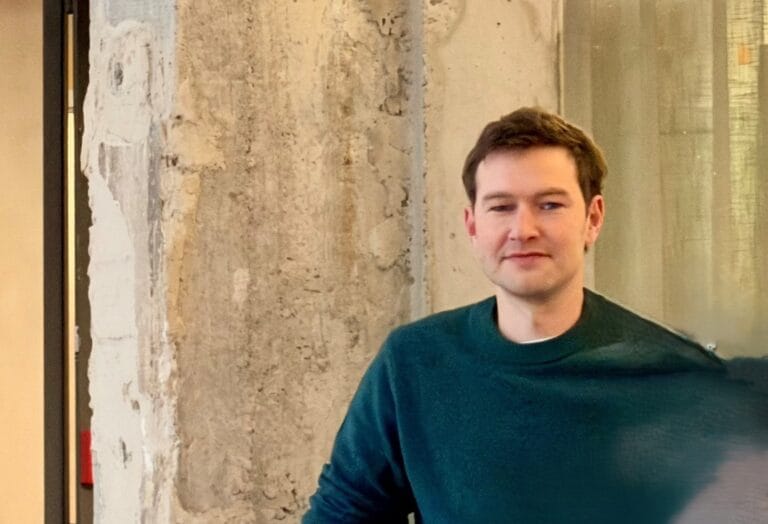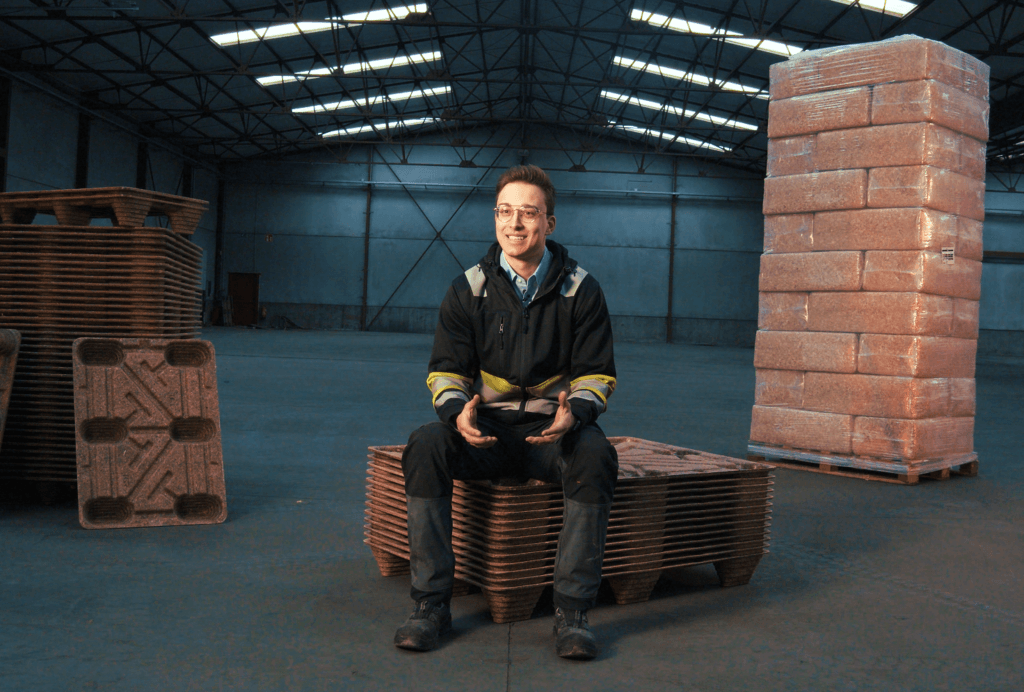
Since early February, the Start2Scale-up Avenue has welcomed a new partner: TGR Pallets. The start-up produces a new type of circular transport pallet. The concept is based on a structure made from miscanthus, a fast-growing and strong crop that naturally absorbs significant amounts of CO₂, combined with a bio-based binder. “These pallets are both lighter and more environmentally friendly than existing wooden pallets,” says Jorden D’hulster, founder and owner of TGR Pallets. He explains why — and what makes the concept unique.
Can you briefly introduce TGR Pallets?
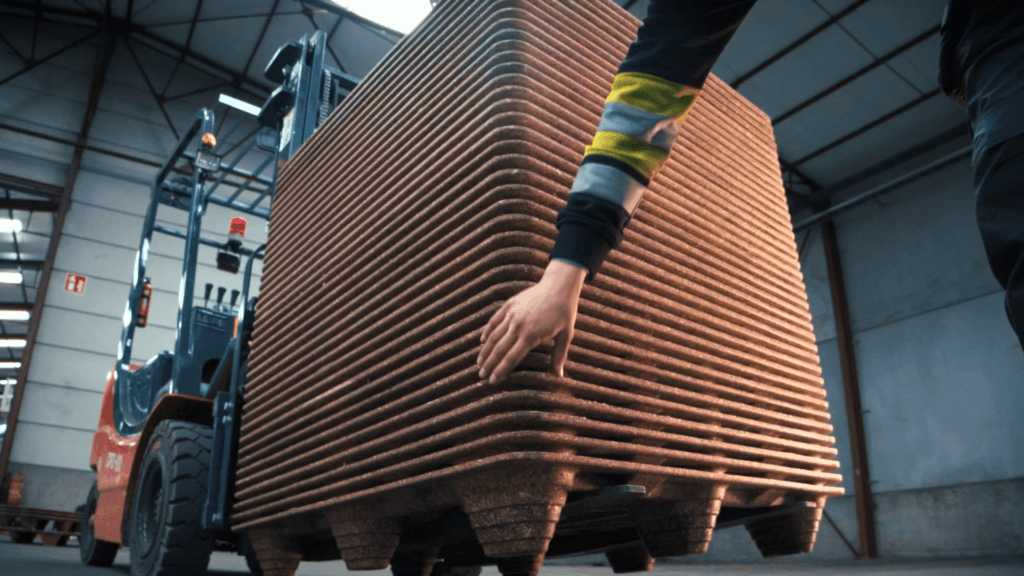
TGR Pallets, which stands for The Green Revolution, produces sustainable and circular pallets made from miscanthus fibres, also known as elephant grass. The fibres are mixed with a bio-based binder and pressed at high temperature. The pallets are robust and can be reused up to ten times. They are nestable, meaning that when stacked they take up significantly less volume than traditional pallets. Sixty TGR pallets form a stack of two metres high, compared to just fifteen wooden pallets.
How did the idea originate?
My academic background is in electromechanics and economics. I started my career as a consultant in soft skills and optimisation and gradually developed a strong interest in circularity and circular solutions. This led me to explore the development of bio-based materials.
My technical background ensured a strong focus on quality requirements, while my economic background meant that any solution also had to make sound business sense.
During the COVID pandemic in 2021, wood prices increased sharply, which also drove up the cost of traditional pallets. Pressed pallets made from alternative raw materials offered an alternative. I therefore started developing a pressed pallet not made from wood chips, like those produced in Austria, the Netherlands and France, but from strong miscanthus fibres combined with a bio-based binder.
The development, carried out in collaboration with VITO, took several years because the combination of fibre material and strict quality requirements is highly innovative. The concept was finalised in 2024, after which I founded TGR Pallets. In 2025, the Belgian investment company Entrevest joined as a shareholder.
Pre-production models were tested, including by DHL, and the concept was validated. Full production started in January this year.
Why use elephant grass?
When pressed, this ornamental grass is exceptionally strong. It is locally cultivated on virtually any type of soil and offers stable pricing. Because it captures large amounts of CO₂, a TGR pallet is CO₂-negative from cradle to gate. This helps companies reduce their carbon footprint.
Compared to pressed pallets made from wood chips, our pallets do not produce splinters. This keeps warehouses cleaner and makes the pallets safer to handle.
The binder is also distinctive, as it is bio-based and 100% free of formaldehyde and PFAS.
How does the production process work?
The production line is located in Boom. It consists of fully automated machines for mixing, high-temperature pressing, trimming and stacking.
The current machinery has an initial capacity of 140,000 units per year and is operated by three people: two employees and myself. The objective is to triple capacity in 2027 and double it again in 2028.
That would result in more than 800,000 pallets per year. That is ambitious.
It is certainly ambitious. However, market feedback has been very positive. As mentioned, the tests at DHL were highly successful. We are also developing a return system to intensify pallet usage and reduce the cost per use.
Trials are ongoing in the automotive sector, including with Renault and VDL, as well as in transport, including with the Dutch company Lily Maas. Our initial focus is on the Belgian market, followed by the Netherlands and Northern France.
The production process is fully automated and standardised, allowing us to scale quickly by adding new machines or replicating the production setup at other locations.
Which sectors are you targeting?
Primarily sectors with significant fulfilment and order picking activities, ranging from cosmetics and automotive to manufacturing, spare parts, 3PL and e-commerce.
Our pallets are particularly suitable for companies, distribution centres and sorting hubs with limited storage space. Because they are nestable, they require at least four times less floor space than traditional pallets. In addition, fewer forklift movements are needed for transport.
Air freight also presents opportunities, as our pallets are lightweight, heat-treated and available as one-way pallets.
What are the disadvantages compared to traditional wooden pallets?
The Europallet is standardised and produced in very large volumes, which creates economies of scale. It can also be repaired. If our pallet is damaged, it cannot be repaired. However, once recovered, it can be shredded and reused as raw material to produce new pallets.
In the current design, there is no bottom board, which means the pallet cannot be placed in racking without grid supports. The intended use is primarily for picking and outbound flows, which often do not require rack storage. Nevertheless, we recognise that such demand may arise and are therefore developing a new type suitable for racking.
Are there additional plans for the future?
The product itself is fully developed. It is robust, lightweight, heat-resistant, water-resistant and reusable multiple times.
We are now focusing on optimising return processes at end-of-life to better streamline waste flows and maximise the reuse of raw materials. In other words, we aim to further strengthen the circular aspect of the concept.
How did you connect with LogiVille?
At the end of last year, LogiVille organised thematic tours on circular logistics. Our concept aligned perfectly with this theme, so we participated. This resulted in several valuable contacts and leads.
We therefore decided to take a booth this year in the Start2Scale-up Avenue to increase our exposure.
What do you expect from your presence at LogiVille?
Through a more structural partnership, we aim to increase exposure and brand awareness.
By engaging with visitors and other partners, we expect to establish new collaborations — commercial, technological or logistical — for example to design and implement optimised return flows.
We also seek input from logistics companies to support the development of new products. Finally, we want companies to test the pallets themselves and experience firsthand that they are both high-quality and robust.