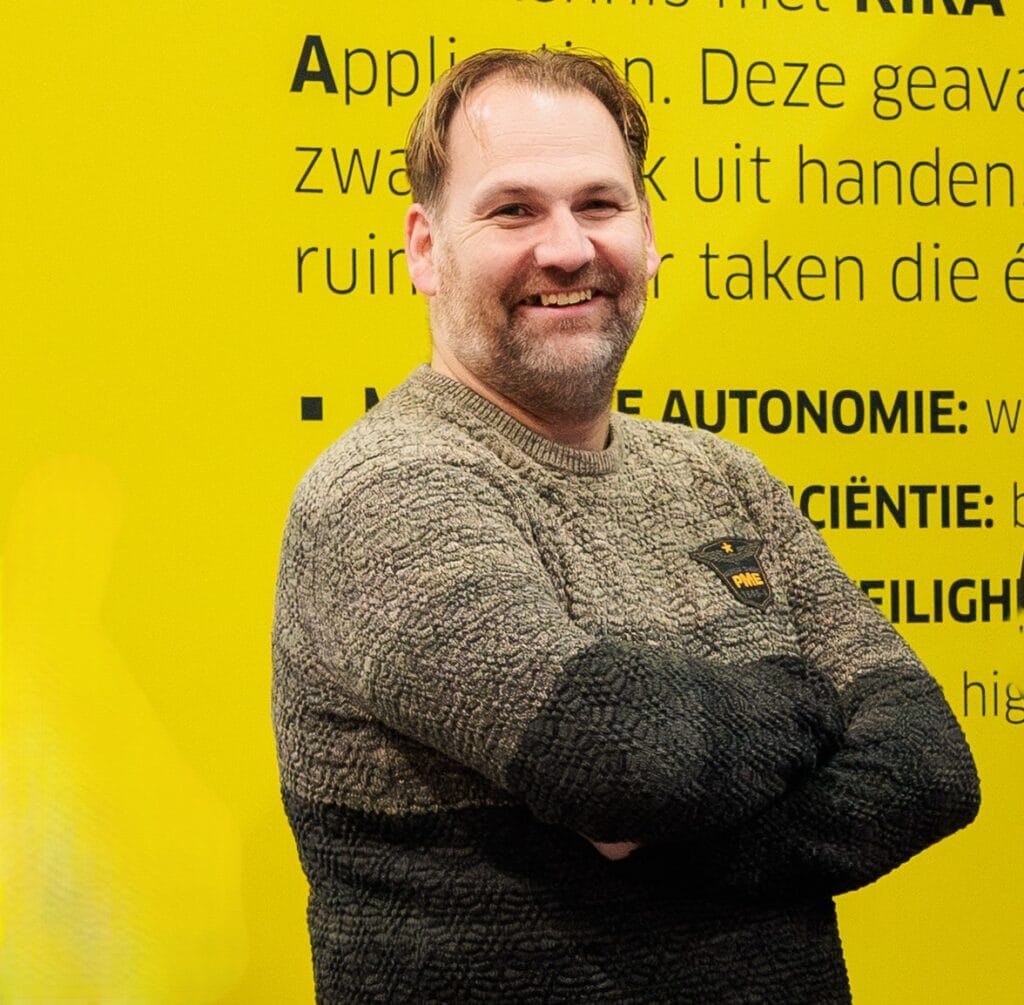
Kärcher Belux has recently become an Innovation Partner of LogiVille. The German company is indeed pioneering robotic cleaning solutions for logistics buildings. These robots can even communicate with transport robots and other AMRs. Jimmy Coussens, Sales Manager Robotic Solutions at Kärcher Belux, introduces the company and the solutions it presents at LogiVille.
Kärcher is widely known among the general public for its high-pressure cleaners and other machines for private use. Since when has it also been active in the industrial and professional market?
Actually, it was the other way around. When Alfred Kärcher founded the company in 1935, the focus was on technical solutions for industry, such as preheating equipment for aircraft engines. The breakthrough in cleaning technology came in 1950 with the first high-pressure hot-water cleaner, intended for professional use. Only from the 1980s onwards did Kärcher also target the private market, using technology originally developed for professional users. Today, Kärcher has two divisions: “Professional” and “Home & Garden”, with professional machines still accounting for slightly more than half of total revenue.
With its industrial solutions, Kärcher also targets the logistics sector.
That is correct. We have twelve target groups, of which logistics and transport, retail, industry and BSC (Building Service Contractors, i.e. cleaning companies) are the core markets.
Kärcher has been active in logistics for quite some time, but the real breakthrough came about fifteen years ago with the rise of mega distribution centres and e-commerce facilities. On the one hand, the surfaces to be cleaned grew larger, increasing the demands on floor-cleaning machines. On the other hand, the need for dust-free environments increased. In e-commerce, for example, many AMRs and AGVs are used. Their sensors function optimally only when there is no dust on the floor or when tyre marks have been removed. Clean warehouses are also a commercial argument: potential customers visiting a distribution centre may be discouraged if the floor is not clean.
Where does the sector’s focus lie?
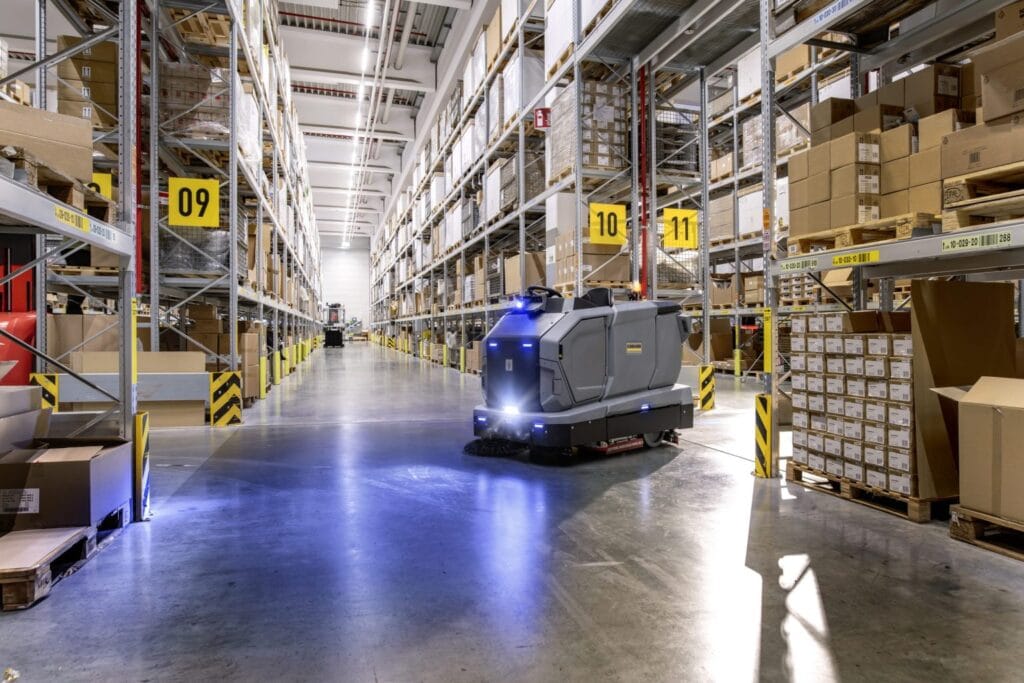
The focus is on floor cleaning machines: scrubber dryers for wet cleaning and sweepers for dry cleaning. These are generally large machines. As logistics buildings often have mezzanines, smaller machines have also been developed specifically for these areas.
How innovative are these machines?
Over the past five years, demand for more autonomous cleaning machines has grown dramatically. Due to labour shortages in the sector, it is difficult to find qualified staff. Companies therefore want to avoid having employees spend time operating sweepers or scrubber dryers. That is one of the main reasons why we have developed robotic machines.
Kärcher was not the first to do so, but it was the first to opt for a 100% robotic solution. This means that not only do the machines drive autonomously, but the docking station is also fully robotic. No human intervention is required to fill the machine with clean water, empty and rinse the dirty water tank or recharge the batteries.
This means that at night, when a warehouse is idle, a machine can operate fully autonomously. It can also operate during the day, even in a busy warehouse. The machines are equipped with sensors that detect people and obstacles and respond accordingly.
Which navigation system do you use for these automated machines?
No specific infrastructure is required, such as beacons or strips. The machines are equipped with two types of sensors: LiDAR scanners and 3D cameras.
We work according to the “teach & repeat” principle: the user drives the route once, and the machine stores it in its memory. Then it repeats it autonomously, with positioning determined by the scanners and cameras. If the machine has to drive around an obstacle — which happens automatically — it always knows where it is and how to continue.
What is the minimum surface area required to make a robotic cleaning machine profitable?
This is difficult to estimate, as the needs of different logistics subsectors vary. In an average warehouse, we are talking about 20,000 m², but in a pharmaceutical zone that must be cleaned daily, it could be 6,000 m² or even less. Generally speaking, a robot becomes interesting when the machine is used for two to three hours per day. However, this is not a fixed rule.
In warehouses, packaging waste or plastic strapping may be left on the floor. How does a robotic cleaner handle that?
If the waste is higher than 6 cm, the robot will drive around it. Smaller waste must be collected; otherwise, the brushes may become blocked. The same applies to manually operated cleaning machines.
It is therefore important to raise staff awareness so that when walking through a warehouse, they pick up foil residues or strapping and dispose of them properly. We also notice that warehouses are becoming increasingly clean. Loose waste is, in any case, detrimental to pallet trucks, forklifts, AGVs and other equipment.
Which robots does Kärcher currently offer?
We offer the CV 50 robotic vacuum cleaner (up to 525 m²/hour) and two scrubber dryer robots: the KIRA B 50 and the KIRA B 200. The first cleans up to 2,300 m² per hour, while the second, which is larger and more powerful, cleans up to 4,900 m² per hour. The KIRA B 200 is therefore particularly suited for cleaning warehouses, industrial halls or airports.
As a side note, KIRA stands for Kärcher Intelligent Robotic Applications.
And in the future?
The latest version of the KIRA B 50 — already the third generation — is built as a platform that allows both smaller and larger machines to be developed. Next year, we will introduce the KIRA B 20, targeting retail, shops and smaller warehouses.
Demand is growing because pressure on staff is increasing: employees no longer have time for cleaning tasks. And frankly, driving up and down aisles is not the most engaging job. Demand for robots is therefore rising because people want to focus more on operational tasks.
Why did Kärcher become a partner of LogiVille?
We first connected with LogiVille during the Transport & Logistics trade fair. We were impressed by the fact that many robotic solutions are demonstrated live. Logistics decision-makers are more easily convinced by live demonstrations than by stationary machines in showrooms or at trade fair stands.
These decision-makers are constantly searching for optimal and efficient solutions and are therefore open to automated technologies. The trend in the sector is clear: “if you can automate it, do it.” Robotic cleaning solutions fit perfectly within this trend.
Could you collaborate technologically with other LogiVille partners?
We certainly see opportunities there. For the KIRA robots, we use the VDA 5050 platform. This is a communication standard for mobile robots in industrial and logistics environments. It enables robots from different manufacturers to collaborate seamlessly within one system.
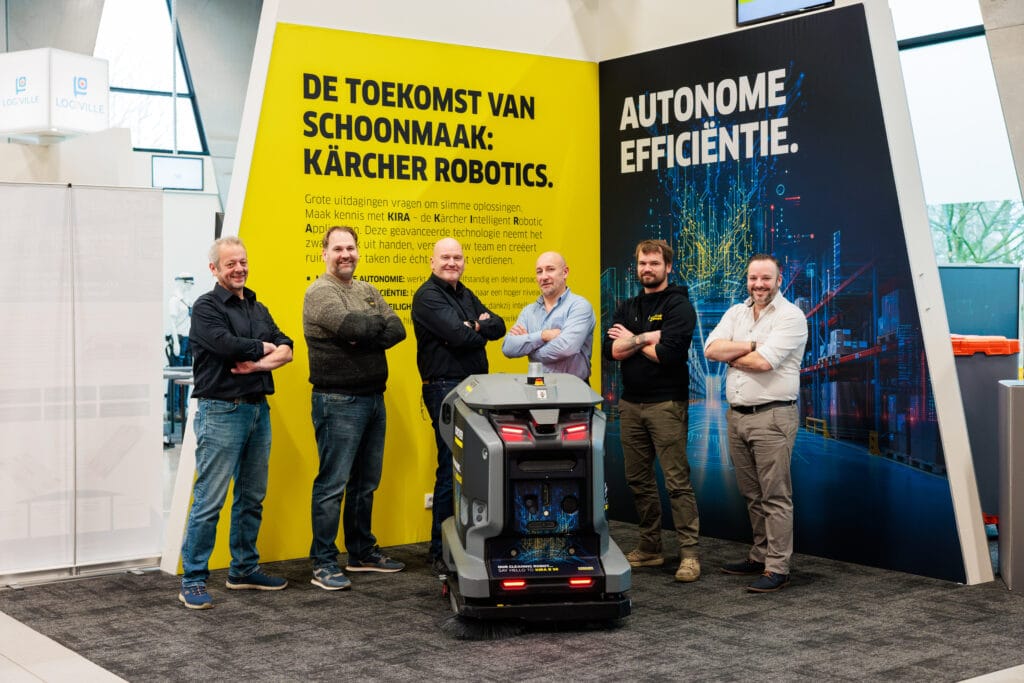
The KIRA robots can therefore work together with transport robots and other AMRs, for example by automatically starting cleaning when a zone becomes available or by communicating with roller doors to move to an adjacent warehouse. Priority rules can also be defined for different autonomous vehicles to prevent congestion at intersections.