“More business, less water stress” – Filip Boelaert (De Vlaamse Waterweg nv)
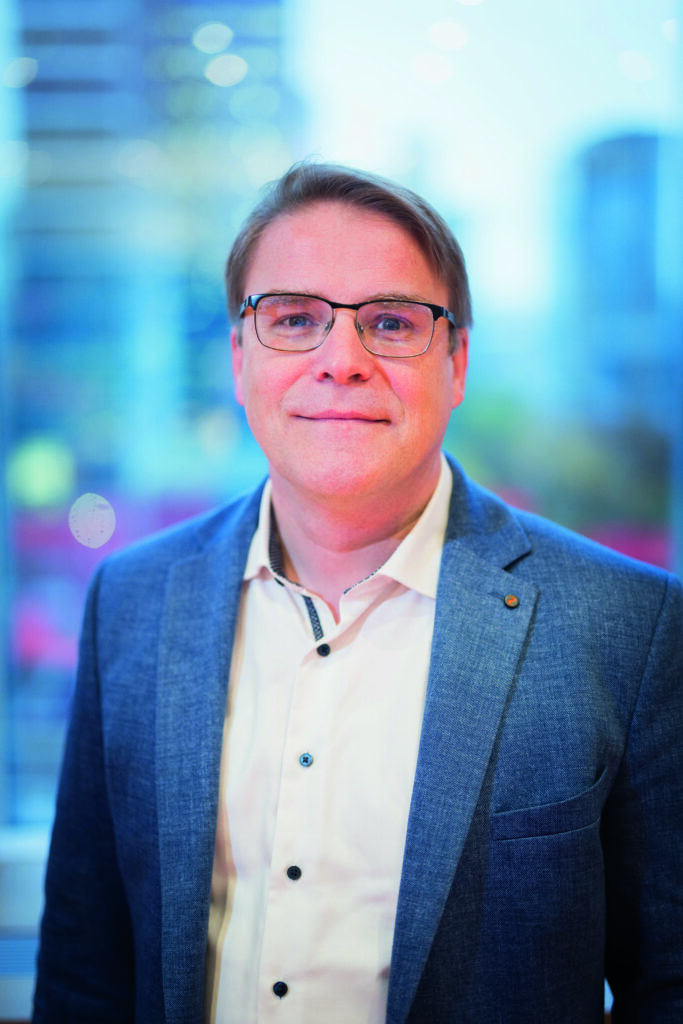
De Vlaamse Waterweg has been working with LogiVille as an Innovation Partner for years, but recently became a Collaboration Partner. This new role is in line with De Vlaamse Waterweg’s broader ambition not only to support innovation in inland shipping, but also to facilitate and stimulate the establishment and development of companies along the waterways. Managing director Filip Boelaert talks about the new strategy and the role that cooperation plays in it.
Vlaamse Waterweg nv is an agency of the Flemish government that manages the waterways in Flanders. Its tasks include strengthening inland shipping, facilitating economic activities on and along the waterway, water management and making the waterways more attractive for transport, logistics, recreation, tourism and nature experience. The head office is in Hasselt and there are departments in Willebroek, Brussels, Antwerp, Merelbeke and Mol. It has about 1,250 employees.
One of your tasks is to strengthen inland shipping. How does that work?
In July, the board of directors approved a new strategy for the first time under the motto ‘More business, less water stress’. We want to facilitate, stimulate and enable entrepreneurship along the waterways even more. We do this together with inland shipping operators, companies and of course partners such as VIL.
This strategy is based on the observation that a modal shift is not an end in itself, but that it is a function of a certain objective, namely making it possible for companies to do business along the water.
‘Less water stress’ in the title of the plan refers to the consequences of climate change. As a result, we will increasingly have to deal with longer periods of drought and heavy rainfall. We must be prepared to make sailing possible at all times. We are already doing that well: this summer we even received compliments from the Netherlands for our approach in Flanders. The ships were able to continue sailing despite the drought, albeit with certain restrictions.
What is De Vlaamse Waterweg doing to attract more ‘business’ along the waterways?
We own land along the waterways and give it as a concession to logistics and industrial companies. We make it possible for those companies to use that land. In addition, we want to focus on the development of new sites, which is not an easy task in today’s Flanders. Such sites are difficult to find and you also have to prepare them for economic activities along the water. With De Vlaamse Waterweg, we want to be the connecting link in this.
Within logistics, we notice that we are known, but within the broader business field, we see that many companies – and even society in general – do not know what we do. Our logistics function is still not visible enough to the general public.
Is there still land available today for companies that want to establish or expand along a waterway?
Very limited. We still have a number of concessions to offer, but there are not many. The available space for entrepreneurship in Flanders is generally very scarce. One of our assignments is to look for new possibilities. We also go to cities and municipalities to point out the potential of inland shipping in the development of their plans for spatial development.
Innovation is a central theme in LogiVille. Inland shipping does have a fairly conservative image. How can De Vlaamse Waterweg help support innovation?
To begin with, I would not say that inland shipping is conservative. Flanders is a leader in innovation in many areas, such as autonomous and semi-autonomous shipping, remote control of ships, remote operation of locks, and so on. Although there are many barge operators who honour traditions – often family ones – that does not mean that they have to be reluctant to innovate. They do ask: “Do it tailored to our companies so that we can keep up.” They look at semi-autonomous vessels with some suspicion and it is therefore up to us to get them on board and stimulate innovation.
For me, there is no contradiction between traditional inland shipping and more innovative inland shipping. If we want to have enough ships in the future, it is necessary to focus on both. An ‘and/and’ story, in other words. That is why we in Flanders were the first in Europe to create a framework for innovative sailing, so that entrepreneurs have sufficient certainty to invest in it.
The initiative for these investments should not come from the government, but from private companies. In Flanders, we can be proud of achievements in the field of autonomously sailing barges, such as the Zulu 4, or remotely controlled ships, including Seafar.
The Vlaamse Waterweg also encourages the greening of the engines. There are still many challenges in this area and we want to provide the necessary incentives. As a government, we can help companies in the initial phase to bridge the gap – innovation takes time and money – but at some point the private sector has to take over. Because otherwise it is an innovation that does not work.
I would also like to refer to the Green Deal for Inland Shipping, which aims to ensure that ships sail emission-free by 2050.
De Vlaamse Waterweg was an Innovation Partner of LogiVille for a long time. Now you are a Collaboration Partner. What does this collaboration entail?
As an Innovation Partner, we did indeed have a ‘booth’ in LogiVille where we interactively explained the possibilities of inland shipping and ‘smart shipping’. But at a certain point you come up against a limit: it is difficult to propose innovations yourself, because the knowledge and development lie with the companies. As mentioned, we are not the innovators ourselves, but we stimulate innovation.
That is why, as a Collaboration Partner, we want to put more emphasis on the possibilities for collaboration – also together with VIL, for example through Baanbrekers – and on substantive input. Various initiatives in collaboration with LogiVille are in the pipeline, such as a podcast… But we are currently working on them further.