“On large sites, a drone combined with perimeter security is particularly valuable” – Johan Vrydag (BauWatch)
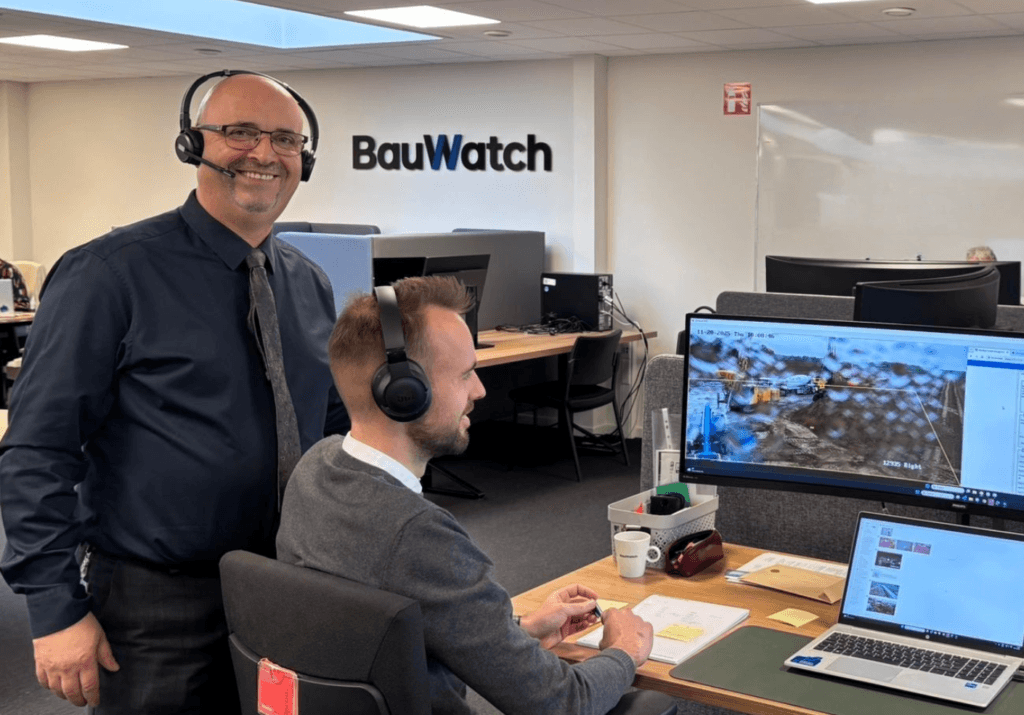
BauWatch has recently become not only an Innovation Partner of LogiVille, but also a Theme Partner of ‘Yards with Brains’. The company specialises in site security through temporary and mobile CCTV surveillance, a field in which it has innovated significantly in recent years. Johan Vrydag, director of BauWatch Belgium, explains how the company operates in the logistics sector and the role that smart technology plays in this.
Could you briefly outline what BauWatch does?
BauWatch specialises in temporary and mobile camera surveillance. We started out in the construction sector, but are now active in around six sectors, including warehouses and logistics sites. The company was founded in 2008 as an innovative project within Visser Assen. This Dutch supplier to the construction sector came up with the idea of fitting lighting columns with cameras to improve site security and prevent theft, vandalism and unauthorised access.
Today, BauWatch is an independent division of the German Haniel Group, operating in 11 countries and with over 50,000 security projects to its name. Around ten years ago, we began incorporating AI into our video surveillance systems. This allowed us to evolve from pure surveillance to broader applications such as monitoring activities, analysing behavioural patterns and similar tasks.
Your core market is temporary and mobile CCTV surveillance. Why this focus?
We started out in the construction sector, where security needs are, by definition, temporary. Theft of materials and machinery costs construction companies a fortune. But other sectors, such as warehouses and logistics sites, are also vulnerable to theft, vandalism and sabotage.
Fixed cameras are not always sufficient, for example because the site is too large or the activities are too variable. The investment in fixed systems is not justifiable for temporary situations. In that context, mobile systems offer much greater flexibility and scalability.
BauWatch installs mobile cameras but does not have security personnel on site. Why?
We deliberately keep our physical presence on site to a minimum so as not to disrupt our clients’ operations. The cameras are linked to our control room in Apeldoorn, which is in direct contact with the police and security services.
We therefore agree protocols with clients so that we can intervene quickly in the event of an intrusion, for example. The masts are also equipped with loudspeakers, which can have a deterrent effect.
Furthermore, that control room is GDPR-certified, which is important for the additional services we offer. This allows us to monitor activities to detect hazardous situations — such as the failure to wear personal protective equipment — and to quantify them objectively. The footage can be anonymised, enabling clients to compile statistics from it and use them for toolbox meetings and safety improvements.
What logistics services do you offer?
Ideally, a logistics site would have a permanent security infrastructure, but this is by no means always the case. During peak periods, companies often need to organise temporary outdoor storage or deploy additional warehouses. In such situations, mobile CCTV surveillance is the most efficient and rapidly deployable solution.
In addition, the outdoor areas — the yards — are a key focus. Whereas the yard used to be seen primarily as a parking area, today it is a complex ecosystem where lorries, trailers, containers, fuel, valuable goods and staff all come together. It is a concentrated area of high value, and therefore an attractive target for organised crime.
Complex liability disputes also frequently arise in the event of damage. Well-documented, continuous monitoring helps to resolve such situations objectively.
How extensive is BauWatch’s presence in Belgium?
BauWatch has been operating in Belgium since early 2020. Due to the coronavirus crisis, our company got off to a particularly rapid start: during the lockdowns, people were at home and burglars shifted their focus to construction sites and logistics sites, amongst other places. As a result, demand for temporary security services rose sharply. In six years, we have grown from four to forty employees, who handle technical, logistical, commercial and administrative tasks.
As mentioned, our control room is located in Apeldoorn, where around ten employees are on standby at all times. They are all trilingual at the very least, which is essential for swift and accurate communication during operations.
In logistics, we mainly work for transport and parcel companies, logistics service providers, ports and terminal operators. In short: for any organisation where perimeter security is crucial and where the dynamics of the outdoor area make fixed camera infrastructure less suitable.
BauWatch uses AI to support its monitoring services. What does that involve?
AI is playing an increasingly important role in our services. Our modules analyse images in real time and ensure that the control room can respond more quickly and accurately. They also help to avoid false alarms and to recognise behavioural patterns. In collaboration with Ghent University, we are also developing predictive models that enable more targeted inspections.
Incidentally, BauWatch is also highly innovative in other areas. For example, we are well advanced in data analysis. The next step is the deployment of BVLOS (Beyond Visual Line of Sight) drones. These make it possible to carry out autonomous inspection flights at any time and measure various parameters. How many vehicles are on site? Are there any suspicious temperature anomalies? Where is the lorry with that number plate? Are there traffic jams heading towards the unloading quays? All of this can be observed during a single flight.
How does BauWatch combine CCTV surveillance with a BVLOS drone?
Suppose we detect a suspicious intrusion at night thanks to our perimeter surveillance. We can then remotely dispatch a drone to fly over that location within 90 seconds. It can scan the area using optical or thermal imaging systems so that, via a direct line to the control room, we can alert the police and report very precisely and accurately where the suspicious situation is occurring.
Are you already using that drone?
We are currently working on a number of proof-of-concept projects, but the service has not yet been commercialised. However, we do intend to launch it in Belgium in the near future. Our partner — we are not drone pilots ourselves — is the only one with a licence to fly under BVLOS conditions throughout Belgium, which is a major advantage.
The combination of perimeter security and drone surveillance makes it much easier for us to secure large sites efficiently. Belgian regulations are very strict: to request a police intervention, there must be a verified alarm situation. This means that visual evidence is always required, which must be confirmed by a trained and certified operator in the control room.
At very large sites, such as port terminals, it is not financially viable to install cameras everywhere. Motion detectors are a more attractive option in such cases, but they do not provide visual footage. By dispatching a drone immediately, we do have that visual footage – and even live. This enables the police to intervene much more quickly and precisely, exactly where the incident is taking place.
When do you think you’ll be able to deploy the drones effectively?
The tests are now in their final phase and we’ll have the final results by the end of April. We’ll therefore be able to start marketing this service to businesses shortly.
In parallel with this, we are working on a long-term project involving various camera systems for customs at the ports of Antwerp and Zeebrugge. We expect to complete this by the end of 2027. This project is taking a little longer because the government applies very strict security procedures.
We are also working on various other innovative projects, including in the areas of fire detection, evacuation and the management of physical accidents. We cannot reveal much about these at present, as we will soon be unveiling these solutions for the first time at LogiVille.
We actually have a great deal more innovation in the pipeline. Our ambition is to showcase a new development in LogiVille roughly every three months.
Do you see opportunities for future collaboration with other LogiVille partners?
Absolutely. We are primarily looking for partners who want to capture the logistics flow within a data stream. The data we generate via our camera footage can enrich their datasets, enabling sites and equipment to be deployed more efficiently.
By combining AI-supported image data with operational data, for example, optimal driving routes can be calculated or processes can be further refined.
To conclude, I’d like to add one more thing: there’s no point in turning every logistics site into a Fort Knox. That doesn’t make economic sense. Security doesn’t start with cameras, but with insight. That’s why we first carry out a thorough risk analysis of the site together with the client, so that the final security plan is smart, proportionate and economically sound.