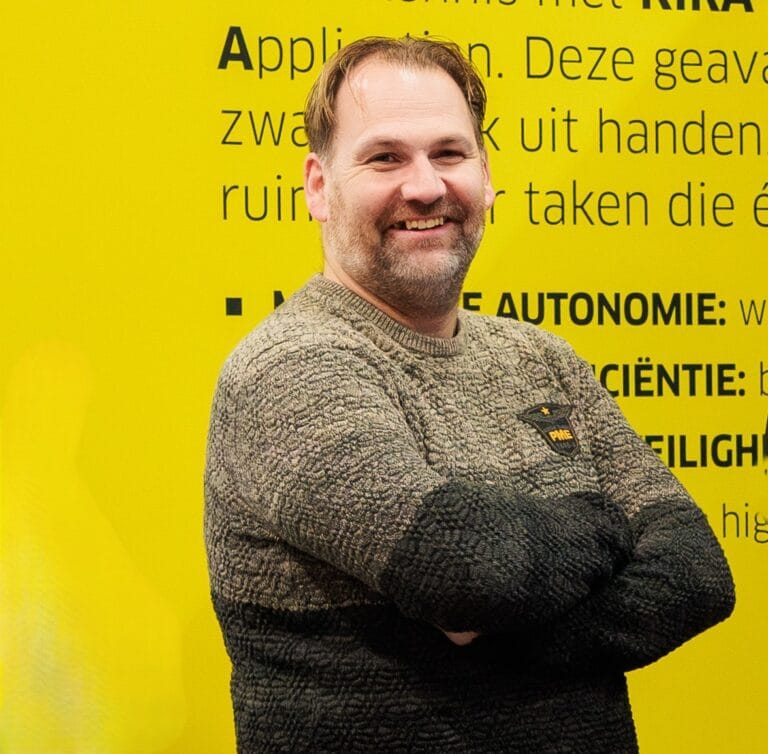
Visitors to the Start2Scale-up Avenue have recently been able to discover Optioryx’s solutions. The Ghent-based scale-up is showcasing Pulse and Flux: a platform for warehouse optimisation and a mobile app that automatically captures operational data, respectively. Co-founder and CEO Bart Gadeyne introduces the company and explains why Optioryx joined LogiVille as a partner.
You are a co-founder of Optioryx. Who did you set up the company with, and what is the idea behind your business?
In 2011, I graduated with a degree in industrial engineering and shortly afterwards joined an air conditioning manufacturer, where I helped to optimise logistics planning. Two years later, I moved to a software company specialising in route planning and transport optimisation, where I wrote algorithms and gained an insight into project management and how to bring SaaS software to market. Building on that experience, I co-founded Optioryx in 2020 with technical co-founders Vic and Gilles. We strongly felt that logistics within warehouses could also be organised much more efficiently.
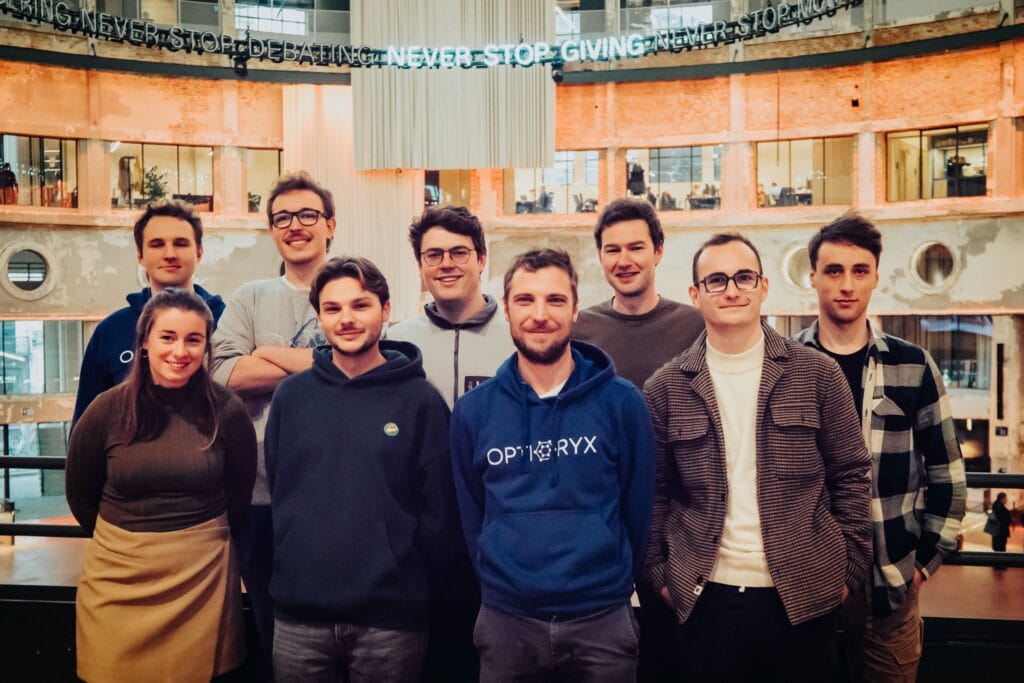
Today, Optioryx is a scale-up with 15 employees based at the Wintercircus in Ghent, a technology hub with a strong focus on innovation and start-ups. We achieved our first commercial success in 2021, and barely two years later we were already taking our first steps into the international market. The growth has been impressive: we now serve around 70 clients in 28 countries. Since early 2025, our turnover has tripled, which means we plan to move into our own office in the near future.
Optioryx specialises in warehouse optimisation. What does that actually involve?
In short: Optioryx improves warehouse processes and dispatch operations by adding intelligence to existing WMS, TMS or ERP systems. With our Warehouse Optimization Software (WOS) platform, we support operational decisions and make warehouses more efficient. Because automation is often expensive and requires lengthy implementation processes, in many cases there is no compelling business case. WOS offers a software-based alternative that quickly optimises existing operations without heavy investment in hardware.
To this end, we offer two products: Pulse, a platform that makes warehouse processes more efficient – particularly around picking, packing and storage – without requiring you to replace your existing systems; and Flux, a data capture and workflow tool that delivers real-time data to WMS, TMS and ERP systems. This data serves as the basis for further optimisation. AI and algorithms play a major role in both Pulse and Flux.
Let’s start with Pulse. Could you tell us more about it?
Pulse is Optioryx’s flagship product. It is an AI-driven optimisation layer that sits on top of an existing WMS. It does not replace the WMS, but rather guides and improves how core warehouse processes operate: picking, packing and slotting.
When it comes to picking optimisation, Pulse focuses on smart route planning and order clustering. This reduces walking distances by 20–50% and boosts picking performance. Using the dashboard, you can run simulations to continuously improve picking routes and efficiency.
For packing optimisation, Pulse optimises how products are placed in boxes and how boxes are arranged on pallets. This also takes transport rates into account. In some cases, it is even better to use two smaller boxes rather than one large one, particularly with volumetric rates. For palletisation, 3D optimisation ensures more stable and efficient stacking and often a reduction in transport costs of around 10%.
The third component is ‘slotting’ optimisation. Pulse determines the best locations for storing SKUs in the warehouse. In doing so, the platform takes into account factors such as turnover rate, product dimensions, walking distances and product relationships, to maximise overall efficiency.
What makes Optioryx unique is that it optimises picking, packing and slotting together within a single platform. Most solutions treat these processes separately, leading to sub-optimal results. Pulse, however, combines them all, thereby maximising the overall efficiency of the warehouse.
Can it be said that Pulse is a tool for implementing strategic optimisations?
Pulse has a twofold purpose. On the one hand, it enables real-time optimisation and execution (of picking, packing and slotting) via integration with the WMS; on the other hand, it allows you to carry out strategic ‘what-if’ analyses within Pulse’s ‘digital twin’ environment. A key feature here is the dashboard, an interactive analysis and visualisation layer. It displays the warehouse’s performance – SKU rotation – in real time and highlights bottlenecks and inefficiencies in ‘heat maps’. The dashboard runs simulations to enable data-driven decisions.
Continuous improvement engineers use the digital twin environment to test improvement ideas: for example, what is the impact on picking productivity if we add a cross-aisle, or if we convert a one-way aisle into a two-way aisle, or what if we were to use a new trolley type. This allows business cases to be substantiated before a decision is made.
Based on the results achieved by our clients, we can state that Pulse delivers a 20 to 50% reduction in walking distance, a 15 to 30% increase in picking productivity, and a 10 to 30% reduction in transport costs.
To summarise: with Pulse, you can carry out operational optimisations in real time (for example: these orders must be picked together in a picking tour, which is immediately executed via a WMS integration), and run strategic ‘what-if’ scenarios in a digital twin environment.
Your second product is Flux. Could you describe it and tell us more about its role?
Whereas Pulse optimises, Flux focuses on collecting, digitising and structuring data. It is a mobile data-gathering platform that allows you to capture and share data directly on the shop floor via smartphones, tablets or handheld scanners.
Pulse can only optimise effectively with reliable and rich data. Flux ensures this: it feeds the WMS with data and extracts information from it at the same time.
Collecting this master data is traditionally expensive and often still done manually or even on paper. With Flux, we take a different approach. Using the mobile app, the user creates their own data flows, such as inbound registration, returns processing, quality checks or compliance checks.
The principle is simple: capturing data where it is generated. Think of scanning a number plate, measuring a pallet or checking a bill of lading. Using photos and AI, Flux automatically converts that input into usable, accurate data. The result: no paper and far less manual work.
A typical application is dimensioning: Flux automatically measures boxes, pallets and SKUs. But the use cases go much further, from damage inspections and returns processing to compliance checks. And the number of use cases is growing exponentially.
Why did Optioryx become a partner of LogiVille?
It was a no-brainer, as this is the place to showcase logistics innovation. We have been working with VIL for some time and had been planning to become a LogiVille partner for a while. At the end of last year, we revamped our branding and introduced the overarching WOS concept, clearly positioning Pulse and Flux as a single suite. Once that was done, we were ready to take the next step.
Through our presence in the Start2Scale-up, we want to make visitors aware that optimisation software can, in many cases, be a fully-fledged alternative to automation and robotisation.
Do you see opportunities for co-creation with other partners?
Absolutely. In fact, that’s one of the reasons behind our partnership. We’re thinking, for example, of collaborating with WMS developers to integrate our solutions directly into their systems, thereby enabling more efficient warehouse processes together.
We also see opportunities for co-creation with, for example, developers of robotic arms to optimise the placement of boxes on a pallet using our algorithms.
We also have a global partnership with Deloitte – also a LogiVille partner – to introduce our latest innovations to larger clients. Thanks to their high-level contacts, they often identify early on where organisations are facing specific challenges. At the right moment, Deloitte can then promote our technology, backed by the strong business cases we have already achieved together.