“Investing in infrastructure to stimulate the modal shift” – Frank Vancoillie (POM West-Vlaanderen)
West Flanders wants to be a leader in sustainable logistics in Flanders. To achieve this goal, POM West-Vlaanderen has launched two new projects: CIRCOHUB in Wielsbeke and LARCOHUB in the LAR logistics zone. POM West-Vlaanderen is a collaboration partner of LogiVille. Frank Vancoillie, Transport and Logistics Project Manager at POM West-Vlaanderen, presents both projects.
POM West-Vlaanderen has been promoting the modal shift for quite some time. It does so by actively persuading and supporting companies. For example, POM West-Vlaanderen works together with Multimodaal.Vlaanderen, a business unit of VIL. The aim is to clearly demonstrate that a modal shift is also economically feasible.
In addition, POM West-Vlaanderen is investing in infrastructure for the modal shift. This will make the region more attractive to companies. The focus is on modern, sustainable, and efficient transport infrastructure. Existing terminals are also being upgraded. CIRCOHUB and LARCOHUB fit perfectly into this strategy.
‘The province wants to continue working on its multimodal accessibility,’ says Vancoillie. ‘West Flanders has two ports: Ostend and, above all, Zeebrugge. In addition, there are several important inland waterways, such as the Leie, the Bruges-Ghent canal and the Roeselare-Leie canal. Rail also plays an important role. There is a lot of industry in the south of the province, which is why we want to maximise multimodal transport there.’
According to Vancoillie, infrastructure is crucial in this regard. ‘It’s a classic chicken-and-egg story. Without infrastructure, there is no demand. Without demand, there is no infrastructure. With CIRCOHUB and LARCOHUB, the province is breaking this vicious circle.’
CIRCOHUB wants to consolidate its growth story
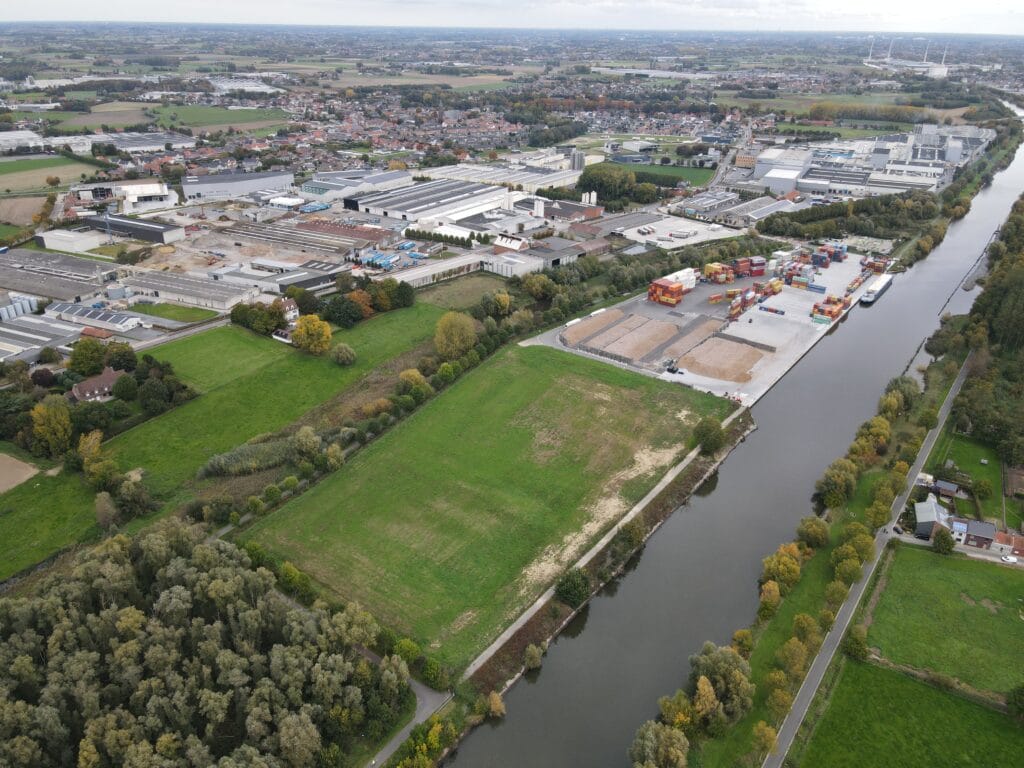
River Terminal Wielsbeke is located along the River Leie. The terminal mainly serves industry in the Kortrijk and Waregem region. It handles both bulk goods and containers. The terminal has been in existence for twenty years. It has experienced strong growth over the past ten years or so.
This growth is remarkable, given that inland shipping in Flanders is experiencing a downward trend. ‘We definitely want to consolidate this growth,’ says Vancoillie. ‘At the current rate, the terminal is likely to reach saturation point within two to three years.’ The future Seine-Scheldt connection will further strengthen this growth. It is scheduled to come into service in 2030.
The growth is partly due to the local industrial fabric. The region is home to companies active in mechanical engineering and flooring. There is also a large food industry and potato processing sector. This type of industry lends itself well to multimodal transport.
Nevertheless, there is an imbalance between imports and exports. Conventional container traffic is largely in balance. This is not the case for reefer container traffic in the food industry. This mainly consists of export flows, which mainly pass through the port of Antwerp. ‘With CIRCOHUB in Wielsbeke, we want to both expand capacity and improve the balance of traffic,’ explains Vancoillie.
Innovating with circular concrete
River Terminal Wielsbeke covers an area of more than 4.5 hectares. It is operated under two concessions. Delcatrans, recently acquired by Gosselin, handles the containers. Shipit is responsible for bulk goods. In 2024, the terminal handled 32,000 TEU and 210,000 tonnes of bulk.
There is room for expansion. The terminal can grow by 3.3 hectares. A third concession will be granted for this purpose. ‘We have no preference for containers or bulk,’ says Vancoillie. ‘Both flows continue to grow in Wielsbeke.’
POM West-Vlaanderen has opted for circular concrete for the paving of the new site. This is an innovative application. The concrete contains recycled materials. Its quality is comparable to that of traditional concrete.
Various tests are currently underway. Three types of circular concrete are being investigated. In addition, there is a pilot project. This should demonstrate how the load-bearing capacity can be optimally utilised. The results will also be applied in other projects at a later stage.
The CIRCOHUB project was approved at the end of last year. The plans are expected at the beginning of 2026. Construction can then start at the end of 2026. Completion is scheduled for October 2027. The allocation of the third concession is running in parallel.
‘With this expansion, we will definitely be ready by 2030,’ says Vancoillie. ‘That is when the Seine-Scheldt connection will be put into service.’
The total project cost is 4 million euros. Of this budget, 1.6 million euros comes from European support from the ERDF. In addition, the Fund for Innovation and Entrepreneurship (FOI), De Vlaamse Waterweg, the province of West Flanders and POM West-Vlaanderen are investing via DLW.
LARCOHUB must whip up rail traffic
West Flanders is not only focusing on inland shipping. Rail transport is also receiving extra attention. With LARCOHUB, POM West-Vlaanderen wants to upgrade the LAR rail terminal. It is located in Lauwe-Aalbeke-Rekkem, between Kortrijk and the French border.
The ambition is clear. LAR must develop into a modern rail consolidation hub for containers. The logistics zone has been in existence for forty years. It is an important player in the south of West Flanders.
Lauwe-Aalbeke-Rekkem is easily accessible by road and rail. It is located on important European trade routes. Several large ports are also within easy reach. Due to its location, the zone serves as a gateway to the French market.
The LAR terminal also has a unique position. It is the only inland rail container terminal in West Flanders. As a result, it plays a key role in the modal shift for the region.
‘After forty years, the infrastructure is in need of renewal,’ says Vancoillie. ‘The current tracks can accommodate trains of up to 420 metres. In Europe, 750 metres is the norm today. That is a serious handicap.’
The available yard capacity is also limited. This puts pressure on profitability. Moreover, the current concession, which was awarded to Delcatrans, is due to expire soon. The province is seizing this opportunity to invest in modernisation and expansion.
Upgrading and expansion
Today, the terminal receives three to four trains per week. There are three tracks, but only one is actually in use. Handling is carried out using a single reach stacker.
POM West-Vlaanderen wants to increase this number significantly. The goal is one to two trains per day, which must be 750 metres long. Because it is not possible to extend the tracks, trains will be split up.
Another option is to lay additional tracks. This would allow a gantry crane to be used. A consultancy firm is currently investigating the various scenarios.
In addition, the yard is also being expanded. This presents structural challenges. There is a difference in height on the additional site. Moreover, the work must be carried out while the terminal remains operational.
The LARCOHUB project was approved by the ERDF in March. The study work is in full swing. The plans must be ready in the course of the first semester of 2026. Construction is expected to start in early 2027. The renovated terminal should be operational in early 2028. By then, the new operator will also be known.
The total budget amounts to €5.25 million. Europe is contributing €2.1 million via the ERDF. The remaining funds come from the Fund for Innovation and Entrepreneurship, the province of West Flanders, the intermunicipal association Leiedal and POM West-Vlaanderen via DLW.
POM West-Vlaanderen
Would you like to learn more about this collaboration partner? Read more about POM West-Vlaanderen here.