“With Dynamic Zone Picking, you drastically reduce walking distances” – Pieter Thijs (Zetes)
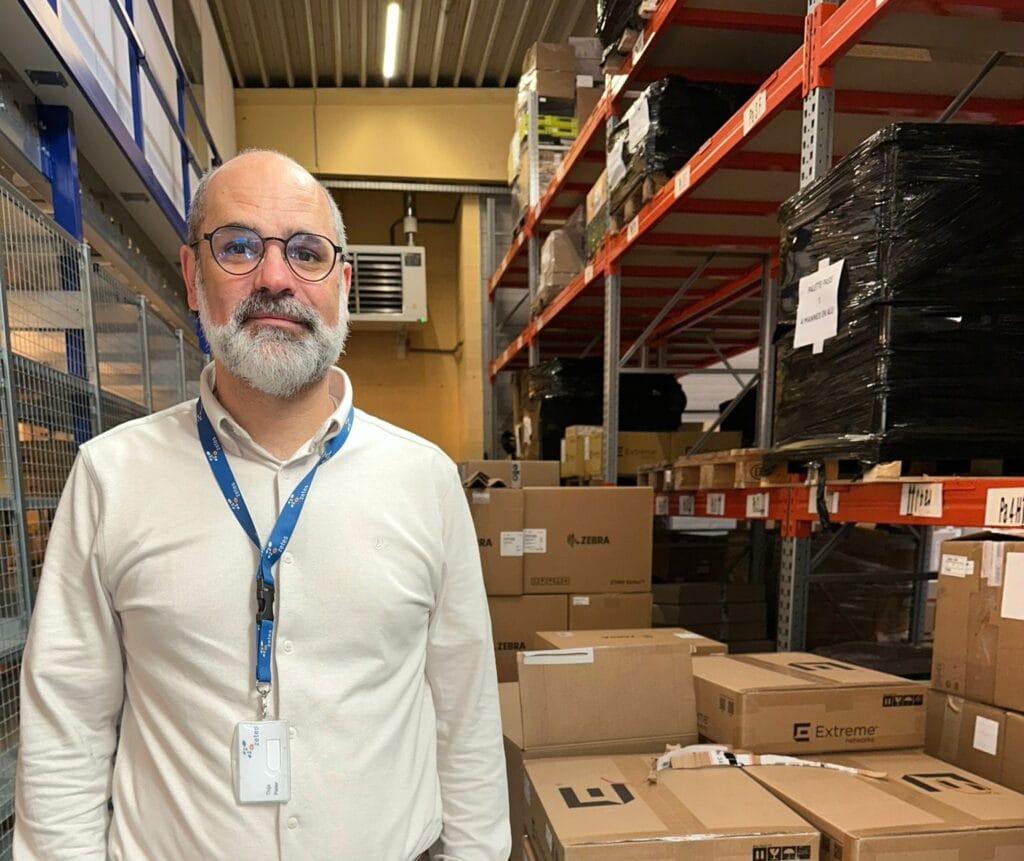
Zetes has been an Innovation Partner of LogiVille for many years. The company regularly presents new products and innovative systems. Today, Pieter Thijs, Business Consultant Supply Chain Solutions, puts the Dynamic Zone Picking concept in the spotlight. It is an advanced picking method in which pickers have to walk much less, and software controls them in real time. This method drastically optimises picking operations, partly thanks to the use of AMRs.
Can you briefly explain what Dynamic Zone Picking is?
Zone Picking is a general warehouse strategy in which a warehouse is divided into zones. Each picker works in a certain zone, reducing walking distances and increasing productivity. Dynamic Zone Picking goes a step further: zones – for example, a corridor or part of a corridor – are dynamically managed based on the current workload; in addition, the WMS or the execution platform – such as Medea – can also move pickers to busier zones.
The main intention is therefore to drastically reduce walking distances so that the pickers can work to the maximum. Dynamic Zone Picking, as a concept, is therefore just below goods-to-person (G2P) systems, where the picker does not have to move because the goods come to them.
AMRs play a leading role in Dynamic Zone Picking.
Dynamic Zone Picking uses AMRs that drive from pick position to pick position and, once full, move autonomously to the packaging or outbound zone. These AMRs can be of different types: multi-order systems for small items, pallet carriers for different boxes or even mobile racks.
The pickers themselves are controlled within their zone by pick-to-light, voice picking and so on. When the picking task is done, the operator confirms, and the AMR can move to the next position.
So, Dynamic Zone Picking is an advanced method for automating picking in combination with AMRs?
Indeed. I will put it more clearly. When it comes to automating picking with AMRs, there are different levels to consider. The first is to automate the ‘pre-picking’ or ‘post-picking’. The AMR brings an empty pallet to the operator. For example, it uses a pallet truck to go from pick position to pick position. Once the pallet is full, the AMR takes it over and automatically delivers it to the desired zone, such as the packaging zone. Picking is therefore still done conventionally. You only automate the phases before and after the picking process.
At the second level, the AMR can follow the picker during his task. When the AMR is full, it leaves for the desired zone, and another AMR is ready to follow the operator. So there is still a lot of running.
The third level is Fixed Zone Picking. Each picker has a certain zone. For example, picker 1 is active only in aisle 1, picker 2 only in aisle 2, and so on. The AMR drives from aisle to aisle, gradually filling it.
The fourth level is Dynamic Zone Picking. You make picking so dynamic that there are no waiting times between pickings, you avoid congestion, and you deploy your people only where they are needed. They only have to walk to a very limited extent. So you ensure your people work continuously and optimally.
The fifth level is the goods-to-person system.
What is the biggest advantage of Dynamic Zone Picking over G2P?
You achieve maximum optimisation of picking activities without having to intervene in your warehouse’s existing structure. If your racks are already there, a G2P solution is less attractive. You also don’t have to create a defined zone.
With a G2P solution, the number of picking lines per person is maximum because they don’t have to move at all. But you have to start from scratch or completely redesign your building. With Dynamic Zone, the number of pick lines is slightly smaller but still optimal because the walking distances are so short.
Does the WMS play a central role in Dynamic Zone Picking?
This can be the WMS, but also an intermediate execution platform. That is one of our specialities. We have a suite of software platforms – such as Medea – that focus on execution and make processes as efficient as possible.
Within our Medea platform, we have an intermediate layer to which we can link different technologies. This can range from a simple handheld application to advanced AMRs. We can also add business logic that is either not present in the WMS or only partially present.
We always need a main system that gives commands to the Medea platform. It divides the tasks and manages different technologies or combinations of them. For example, with Dynamic Zone Picking, you not only have to control the AMRs but also manage people via a voice system.
In other words, through Medea, we ensure that the AMRs are available at the right time and in the right place, that people are in the right place and at the right time, and that they know which goods to pick and place on the AMRs.
From what order of magnitude of operations can Dynamic Zone Picking be justified?
That’s hard to say because it depends on many factors, such as SKU variation and order predictability. If you have many small orders with a wide variety of SKUs, long walking distances, high growth expectations, or many same-day or next-day orders, then Dynamic Zone Picking is certainly worth considering.
Depending on order volumes, variability, and labour intensity, Dynamic Zone Picking can, in some cases – roughly calculated – already handle 20 pickers in a warehouse of 5,000 to 10,000 m². Suppose you have about 10,000 orders per day and 25 to 30 pickers at work; then you can already achieve a decent ROI.
Sectors that benefit from Dynamic Zone Picking include e-commerce, retail, automotive parts, electrical products, and the like.
Incidentally, there is another advantage: staff retention. In those sectors, walking distances can be very long, and pickers spend 60% of their time walking and only 40% doing something useful. This is frustrating for many employees.
You do increase the workload.
Okay, the workload increases for the picker because his time is used very efficiently, but his added value – the picking itself – is better expressed. That gives him satisfaction.
And walking around with a pallet truck is also physically tiring. If you minimise walking distances, pickers have more job satisfaction.
Are there already many applications of Dynamic Zone Picking in Belgium?
Not yet. The number of AMRs in logistics environments is still quite limited in Belgium. We do notice that demand for AMRs is clearly rising, partly due to the staff shortage. We expect interest in Dynamic Zone Picking to grow because it is the next logical step.
Indeed, you should not start with a ‘big bang’. Within an existing building, you can start with AMRs to drive from A to B and gradually add new applications, eventually arriving at Dynamic Zone Picking.
The fact that there are few applications in Belgium is also due to the fact that a lot of attention is currently being paid to G2P, and that such systems are being prioritised. After all, Dynamic Zone Picking is a fairly recent concept, which is still too little known. Many therefore do not know that the system is almost as profitable as G2P but requires considerably less investment.